What Age Do Kids Color Inside the Lines?
Quick answer
Most children begin coloring inside the lines around ages 4 to 5, and do it fairly consistently by 5 to 6. Before that, coloring outside the lines is completely normal and important for building control. Larger, simpler pictures help younger children succeed sooner.
By the TheColoringPages.net team. Reviewed for accuracy, September 2026.
This guide to Inside the Lines gives clear, practical answers, drawing on fine motor skills and years of hands on coloring.
Watching a young child color outside the lines, parents often wonder when their child will color neatly. The answer is later than many expect, and there is no reason to rush it. Coloring inside the lines is a developmental milestone that arrives when a child’s hands and eyes are ready, usually around school age. Before then, coloring outside the lines is not a problem to fix but a healthy stage to enjoy.
This guide explains the typical age children color inside the lines, why it takes that long, and how to support the skill gently without pressure.
Quick answer: Most children can color inside the lines around ages 5 to 6, once fine motor control and hand and eye coordination mature. Before that, scribbling and going outside the lines is normal and healthy, and it should not be corrected or rushed. The ability arrives naturally as a child’s hand control develops.

The typical age
Coloring inside the lines is a later milestone than parents often assume.
Most children can color inside the lines around 5 to 6 years old. Some manage it a little earlier, around 4, and others a little later, all within the normal range. This ability marks the point where a child’s fine motor control and hand and eye coordination have matured enough to guide a crayon precisely along a boundary.
It is important to see this as a milestone that arrives, not a skill to be taught early. A child colors inside the lines when their body is ready, in much the same way they walk or talk when ready. Pushing it before that readiness does not speed it up and can cause frustration.
So if your four year old colors well outside the lines, that is completely normal. The neat coloring will come as their hand control develops, built on all the free coloring and scribbling that came before. Our guide on coloring and child development covers the full sequence of stages.
Why it takes until then
Understanding why this milestone arrives around 5 to 6 helps you be patient with it.
Coloring inside the lines requires several skills to come together. The child needs fine motor control, the precise command of the small hand muscles, to guide the crayon exactly where they want it. They need hand and eye coordination, so the eye can track the line while the hand follows it. And they need the visual perception to see the boundary and understand it as a limit to stay within.
These skills develop gradually over the early years, built through scribbling and free coloring. A toddler simply does not yet have the muscle control or coordination to stay in the lines, no matter how much they might want to. The ability is a product of physical development, which cannot be rushed.
This is why coloring inside the lines arrives around school age, when these skills have matured. It is also why the same hand control underlies handwriting, which develops around the same time. Our guide on coloring and fine motor skills covers the muscle development involved.
The stages leading up to it
Coloring inside the lines is the final stage of a long developmental sequence, so it helps to see the whole path.
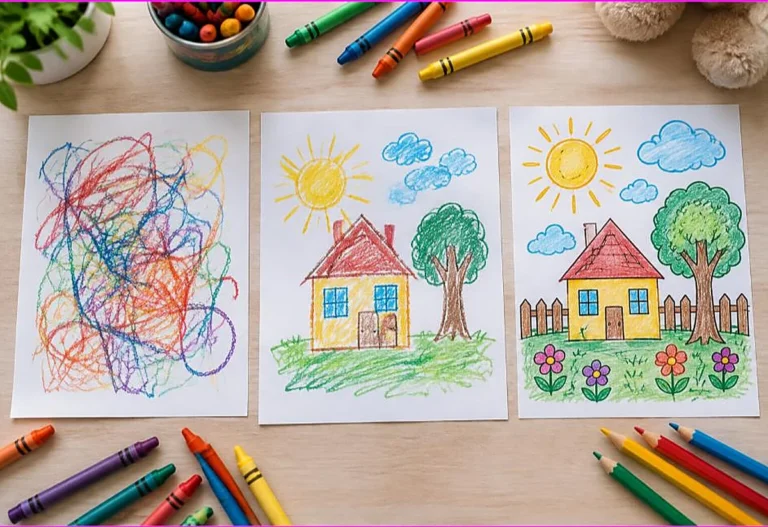
Around 12 to 18 months, children scribble randomly, with no control. Around 2 years, scribbling becomes more controlled, with purposeful marks. Around 3 years, children fill shapes loosely, going well outside any lines. Around 4 years, they color with more intent, staying roughly within a large area but still crossing lines. By 5 to 6 years, most can color inside the lines.
Each stage builds the skills for the next. The wild scribbling of a toddler develops the hand strength that later precision needs. The loose filling of a preschooler develops the control that eventually allows staying in the lines. Every messy page is practice moving toward the neat one.
Seeing this sequence helps you value each stage rather than wishing your child were further along. A child crossing the lines at four is exactly where they should be, doing the work that leads to staying in the lines later. Our guide on what age kids start coloring covers the earliest stages.

How to gently support control
You cannot rush this milestone, but you can gently support the developing control.
Offer pages suited to your child’s stage. Large, simple shapes are easier to stay within than tiny, detailed ones, so big bold pages help a child practice control at a level they can manage. As their control grows, offer slightly more detailed pages. Our collection of free printable coloring pages for kids spans simple and detailed designs.
Model coloring without correcting theirs. Coloring alongside your child, staying in the lines yourself, shows them the idea without pressure. You can gently point out lines as boundaries in a playful way, but never criticize their coloring or force them to stay in. Let them practice at their own pace.
Provide plenty of coloring practice in general, since the control develops through use. The more a child colors, in any style, the more their hand skills develop, moving them toward staying in the lines. Keep it fun and frequent, and the skill will come. Our guide on how to teach a child to color covers gentle guidance.
Why not to push it
Pushing a child to color inside the lines before they are ready does more harm than good, so it is worth understanding why.
First, it does not work. The ability depends on physical development that cannot be sped up by pressure. A child who is not ready simply cannot stay in the lines, no matter how much they are pushed, so the pressure achieves nothing but frustration.
Second, it can take the joy out of coloring. A child who is constantly corrected or criticized for going outside the lines may come to dislike coloring, which is the opposite of what you want. The joy and freedom of coloring are what keep a child practicing, and that practice is what develops the very control you are hoping for. Pushing neatness can undermine the whole process.
Third, going outside the lines is not a flaw to fix. It is a normal, healthy stage of development. Some educators even argue that free coloring, unconstrained by lines, supports creativity. So there is every reason to relax about it. Celebrate your child’s coloring at whatever stage they are, and trust that staying in the lines will come in time.
Coloring outside the lines and creativity
There is a positive side to coloring outside the lines that is worth appreciating.
Coloring outside the lines, or in unexpected colors, is a sign of a child exploring and expressing themselves freely. A child who colors a purple sun or scribbles beyond the boundaries is making creative choices and enjoying the freedom of the activity. This creativity is valuable and worth encouraging, not correcting.
As children grow and gain control, many naturally choose to stay in the lines, while still bringing their own creative color choices. The two are not in conflict. A child can develop precise control and remain creative, coloring neatly when they wish and freely when they wish. The goal is not to replace creativity with neatness but to let both develop.
So when your child colors outside the lines, see the creativity and freedom in it, not just the lack of control. Both the developing precision and the creative expression are valuable. Encouraging your child’s coloring at every stage, without pushing neatness, supports both. Our guide on the benefits of coloring for kids covers creativity and skill together.
What the milestone tells you
Reaching the inside the lines milestone tells you useful things about your child’s development.
When a child can consistently color inside the lines, it signals that their fine motor control, hand and eye coordination, and visual perception have matured to a level that supports precise hand tasks. This is the same set of skills that handwriting relies on, which is why the two often develop around the same time. A child coloring neatly is showing readiness for the fine work of forming letters.
The milestone also reflects growing focus and patience. Staying within lines requires attention and care, so a child who colors neatly is demonstrating the ability to concentrate on a precise task and see it through. These are valuable school ready skills.
So the inside the lines milestone is more than a coloring achievement. It is a window into your child’s developing hand skills and focus, which support writing and learning. That said, there is no need to test for it or worry if it comes a little later, since children reach it across a range of ages. Our guide on coloring and handwriting readiness covers the link to writing.

Supporting handwriting through coloring
Because coloring inside the lines and handwriting develop together, coloring is a natural way to support writing readiness.
The hand control a child builds through coloring is the same control handwriting needs. Coloring inside a shape practices the precise, guided movements that forming a letter requires. So a child who colors regularly is building writing readiness without it feeling like work, which is why coloring is considered a key pre writing activity.
You can gently link the two as your child approaches school age. Offering pages with shapes and simple patterns to color, then simple pre writing lines and curves to trace, builds the control writing needs in an enjoyable way. The playful nature of coloring makes this practice feel like fun rather than lessons. Our guide on coloring and fine motor skills covers the hand development involved.
So supporting your child’s coloring, at every stage, quietly supports their handwriting too. There is no need to drill or push. Simply providing plenty of enjoyable coloring builds the hand skills that neat coloring and, soon after, writing depend on. Our collection of free printable coloring pages for kids gives you pages for every stage of this development.
Frequently asked questions about inside the lines
What age do kids color inside the lines?
Most children can color inside the lines around 5 to 6 years old, once fine motor control and hand and eye coordination mature. Some manage it a little earlier or later, all within the normal range.
Why can’t my young child color in the lines?
Coloring inside the lines requires fine motor control, hand and eye coordination, and visual perception that develop gradually. A young child simply does not yet have the muscle control to stay in the lines, which is completely normal.
Should I make my child stay in the lines?
No. The ability arrives with development and cannot be rushed by pressure. Pushing it only frustrates a child and can take the joy out of coloring. Let them color freely, and the control will come in time.
Is coloring outside the lines a problem?
No. Coloring outside the lines is a normal, healthy stage of development and a sign of creative, free expression. It is not a flaw to fix. Children naturally gain control as their hand skills mature.
How can I help my child color more neatly?
Offer large, simple pages that are easier to stay within, model coloring without correcting theirs, and provide plenty of coloring practice. Keep it fun and pressure free, since the control develops through enjoyable practice, not pressure.
The takeaway on inside the lines
Most children color inside the lines around 5 to 6 years old, when their fine motor control and coordination mature. Before that, coloring outside the lines is normal, healthy, and even creative, and it should not be corrected or rushed. Support the developing skill gently with suitable pages and plenty of practice, keep it pressure free, and trust that staying in the lines will come with time. Enjoy your child’s coloring at every stage.
Ready to support your child at their stage? Browse our free printable coloring pages for kids, from simple to detailed. Every one is free to download and print. For ready made packs, browse our educational coloring pages.