What Is a Mandala? (Meaning, Origin, and Why We Color Them)
Quick answer
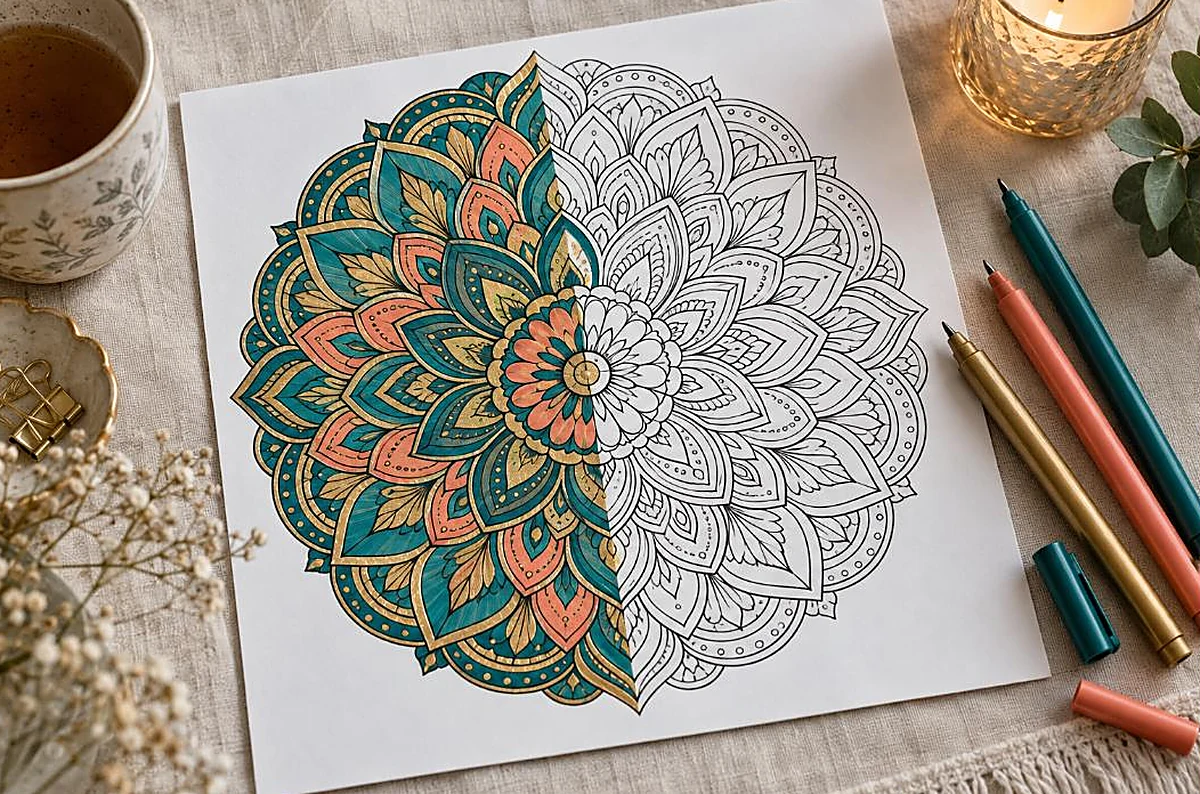
A mandala is a circular design built outward from a central point in balanced, repeating patterns. The word is Sanskrit for “circle,” and the form has deep roots in Hindu and Buddhist traditions, where it symbolizes wholeness and the universe. Today, mandala coloring pages are popular for relaxation because their symmetry makes them calming and meditative to fill in.
By the TheColoringPages.net team. Reviewed for accuracy, September 2026.
This guide to Mandala gives clear, practical answers, drawing on the mandala and years of hands on coloring.
Mandalas are among the most popular and calming designs to color, but they are much more than pretty patterns. The word has deep spiritual roots, and the circular, symmetrical form carries meaning that stretches back centuries. Understanding what a mandala is, where it comes from, and why it is so soothing to color adds richness to the experience.
Quick answer: A mandala is a circular, symmetrical design radiating from a center point. The word means circle in Sanskrit, and mandalas have spiritual roots in Hindu and Buddhist traditions. Today they are popular coloring designs prized for their calming, meditative symmetry. Coloring a mandala is soothing because of its balanced, repeating structure.

Definition and meaning
A mandala is a circular design built around a center, with patterns radiating outward in a symmetrical way.
The defining features of a mandala are its circular form, its central point, and its symmetry. The design radiates from the center outward, with patterns that repeat symmetrically around the circle, creating a balanced, harmonious whole. This circular, symmetrical, centered structure is what makes a design a mandala. The word mandala itself comes from Sanskrit, an ancient language of India, and means circle.
Beyond the literal circle, mandalas traditionally carry a deeper meaning of wholeness, unity, and balance. The circular form with its center is seen as representing the universe, completeness, or the self, depending on the tradition. This symbolic meaning gives mandalas significance beyond their beauty, though you do not need to know it to enjoy coloring them. The form itself, balanced and centered, has an inherent sense of harmony.
Today, mandalas are widely known as coloring and art designs, prized for their intricate, symmetrical beauty and their calming quality. While their spiritual meaning remains, they are enjoyed by many simply as beautiful, soothing designs to color. Understanding that a mandala is a circular, symmetrical, meaningful design helps you appreciate what you are coloring. Our guide on the benefits of mandala coloring covers why they soothe.
Origins in Hindu and Buddhist traditions
Mandalas have deep roots in Hindu and Buddhist traditions, which is worth understanding.
In Hinduism and Buddhism, mandalas have long been used as spiritual and ritual symbols. They represent the universe, the cosmos, or spiritual concepts, and they serve as tools for meditation and focus. Creating and contemplating a mandala is a spiritual practice in these traditions, used to aid concentration, reflection, and a sense of connection to something larger. The mandala’s balanced form supports this meditative focus.
In Buddhist tradition, intricate sand mandalas are created as a meditative and ritual practice, then ceremonially dismantled, symbolizing impermanence. In Hindu tradition, mandalas appear in art, architecture, and ritual as sacred symbols. These uses show how central and meaningful mandalas are in these traditions, far beyond decoration. The creation of a mandala is itself a focused, meditative act.
This spiritual heritage is part of what gives mandalas their special quality. When you color a mandala today, you are engaging with a form that has been used for centuries to focus and calm the mind. This connection adds depth to mandala coloring, even for those coloring simply for relaxation. Understanding the origins enriches the experience, linking a modern coloring page to an ancient, meaningful tradition. Our guide on how to color mandalas covers coloring them.
Carl Jung and psychology
Beyond their spiritual roots, mandalas have a place in psychology, thanks to Carl Jung.
Carl Jung, an influential psychologist, took an interest in mandalas in the twentieth century. He noticed that people, across cultures, often spontaneously created circular, balanced, mandala like designs, especially when seeking a sense of order, wholeness, or calm. Jung came to see the mandala as an expression of the self and the psyche’s drive toward balance and integration. He even used mandala drawing in his own work and with patients.
Jung’s interest brought the mandala into Western psychology and art therapy, where creating or coloring mandalas is used as a calming, centering, self exploratory activity. This psychological view sees the mandala as a natural, universal form that reflects and supports the mind’s search for balance. It is part of why coloring mandalas can feel so satisfying and settling, tapping into this drive toward wholeness.
So mandalas carry meaning in psychology as well as spirituality, both connected to their sense of balance and wholeness. This is part of why filling a mandala can feel quietly centering, beyond just being a pretty pattern. Understanding the psychological dimension adds another layer to appreciating mandalas. Whether viewed spiritually, psychologically, or simply as beautiful designs, mandalas have a depth that enriches coloring them. Our guide on the benefits of coloring for adults covers coloring’s calming effects.

Why mandalas are used for coloring
Mandalas are especially popular for coloring, and understanding why helps explain their appeal.
Mandalas are beautiful and intricate, offering a satisfying, absorbing coloring experience. Their detailed, symmetrical designs give plenty to color and reward careful work with a stunning result. The intricacy suits adult coloring especially, providing a long, immersive session. This beauty and intricacy are a big part of why mandalas are such popular coloring designs.
Mandalas are also uniquely calming to color, thanks to their structure. The repeating, symmetrical pattern gives the mind a clear framework to follow, and coloring the matching sections in a steady rhythm is soothing and meditative. Research suggests coloring mandalas lowers anxiety more than free form coloring, likely because of this structure. Our guide on the benefits of mandala coloring covers this calming effect.
The symmetry also makes mandalas beginner friendly and satisfying, since coloring matching sections consistently creates a beautiful, balanced result almost automatically. You do not need artistic skill to color a mandala beautifully, just follow the symmetry. This combination, beauty, calm, and accessible satisfaction, is why mandalas are among the most beloved coloring designs. They offer a soothing, rewarding coloring experience for any age. Our guide on how to color mandalas covers the approach.
Types of mandalas
Mandalas come in various types and styles, so it helps to know the common ones.
Traditional mandalas follow the classic circular, symmetrical, spiritual form, often with concentric rings of detailed patterns radiating from the center. These carry the traditional meaning and offer intricate, absorbing coloring. Geometric mandalas emphasize precise geometric shapes and patterns, giving a clean, structured design. These suit people who like order and precision in their coloring.
Nature and floral mandalas incorporate natural elements like flowers, leaves, and organic shapes into the mandala form, giving a softer, more organic feel. These are popular for their beauty and their blend of the mandala structure with natural motifs. Animal mandalas feature animals arranged in a mandala form, combining the appeal of animals with the calming symmetry. These varied styles suit different tastes.
Mandalas also range from simple to highly intricate, suiting different ages and skill levels. Simple mandalas with larger sections suit beginners and children, while intricate ones suit adults who want detailed, immersive coloring. Whatever the style or complexity, the mandala’s circular, symmetrical form gives it its calming, satisfying quality. This variety means there is a mandala for every taste and level. Our collection of free printable coloring pages includes mandalas in many styles and levels.
Coloring your first mandala
If you are new to mandalas, here is how to approach coloring your first one.
Choose a simple mandala with larger sections for your first, so it is manageable and satisfying. A simpler mandala lets you experience the calming rhythm without being overwhelmed by tiny details. Plan a small palette of a few colors that work together before you start, which keeps the process flowing and the result harmonious. Our guide on what colors go together helps you choose.
Color systematically, often from the center outward, using the symmetry by coloring matching sections the same. This creates the balanced mandala look and makes coloring easier, since you repeat your colors around each ring. Work at a slow, relaxed pace, focusing on the calming rhythm rather than perfection. This turns coloring a mandala into a soothing, meditative experience. Our guide on how to color mandalas covers the approach in detail.
Above all, enjoy the process and the calm it brings. Mandalas are meant to be soothing to color, so let go of any pressure and savor the meditative rhythm of filling the symmetrical sections. Whether you color for relaxation, beauty, or the connection to the mandala’s rich meaning, your first mandala can be a genuinely calming, rewarding experience. From there, you can explore more intricate mandalas as you wish. Our collection of free printable coloring pages includes mandalas for every level.

Mandalas beyond coloring
Mandalas appear in many forms beyond coloring pages, which shows their wide appeal and meaning.
In art and design, mandalas appear in paintings, textiles, jewelry, tattoos, and architecture, valued for their balanced beauty and symbolic depth. The mandala form’s harmony makes it a popular decorative and artistic motif across cultures. Seeing mandalas in these forms shows how the design resonates widely, beyond the coloring pages where many people encounter it today.
In wellbeing and mindfulness, mandalas are used for meditation, relaxation, and art therapy. Creating, contemplating, or coloring a mandala is a recognized calming practice, tapping into the form’s meditative quality. This is why mandala coloring is so popular for stress relief, and why mandalas feature in mindfulness and therapy settings. Our guide on mindful coloring covers coloring mandalas mindfully.
Understanding mandalas beyond coloring deepens your appreciation of them. When you color a mandala, you are engaging with a form found in art, spirituality, psychology, and wellbeing across the world and through history. This rich context makes mandala coloring more than a pastime; it connects you to a meaningful, universal design. Whether you color mandalas for calm, beauty, or their deeper meaning, they offer a uniquely rich and soothing coloring experience. Our collection of free printable coloring pages includes many mandalas to explore.
Frequently asked questions about mandala
What is a mandala?
A mandala is a circular, symmetrical design radiating from a center point. The word means circle in Sanskrit. Mandalas have spiritual roots in Hindu and Buddhist traditions and are popular today as calming, meditative coloring designs.
What does mandala mean?
Mandala comes from Sanskrit and literally means circle. Beyond the literal meaning, mandalas traditionally represent wholeness, unity, and balance, and in Hindu and Buddhist traditions they symbolize the universe and serve as tools for meditation.
Where do mandalas come from?
Mandalas have deep roots in Hindu and Buddhist traditions, where they are sacred symbols representing the universe and tools for meditation and focus. They appear in art, architecture, ritual, and practices like Buddhist sand mandalas.
Why are mandalas good for coloring?
Mandalas are beautiful and intricate, offering absorbing coloring, and uniquely calming thanks to their symmetrical structure. The repeating pattern gives a soothing rhythm, and the symmetry makes them beginner friendly and satisfying, creating beautiful results.
Are mandalas religious?
Mandalas have religious origins in Hindu and Buddhist traditions, where they are sacred symbols. Today, however, they are widely enjoyed simply as beautiful, calming coloring and art designs, without any religious meaning for many who color them.
The takeaway on mandala
A mandala is a circular, symmetrical design radiating from a center, whose name means circle in Sanskrit. Mandalas have deep spiritual roots in Hindu and Buddhist traditions, representing wholeness and serving as meditation tools, and they hold meaning in psychology through Carl Jung’s work on the mind’s drive toward balance. Today they are beloved coloring designs, prized for their beauty and their uniquely calming, meditative symmetry. Understanding what a mandala is enriches the soothing, satisfying experience of coloring one. Each time you fill one in, you are taking part in a form that has meant something to people for a very long time.
Ready to color a mandala? Browse our free printable coloring pages, including mandalas in many styles and levels. Every one is free to download and print. For ready made packs, browse our mandala coloring pages.